
SaaS content writing that converts is arguably more important than in any other industry. By nature, its audience is actively online and desperate for a solution to their problem.
In fact, 98% of SaaS companies host blogs on their websites, and nearly 50% of buyers read a company’s blog before making a purchase.
So, writing a blog is easy enough, right? But how do you make it convert and not just another piece of slop?
As an experienced Saas content writer, I’m here to explain the 101 of my craft:
What Makes SaaS Content Writing Unique?
In most cases, a SaaS company’s audience already has a vague idea of the solution they need. So, the SaaS content writer’s goal is to convince a reader about how the software helps solve a problem.
This makes it unique to other forms of marketing, as you’ll be explaining:
- How it works
- What the features are
- Why they should invest in it
Tone of voice is critical here, as the writer must explain complex software concepts in simple yet convincing language. It’s about preventing overwhelm without holding back crucial selling points.
This can be achieved in various ways:
Core SaaS Content Types You Need
Educational Blog Posts (Top of the Funnel)
Readers at the top of the funnel are those searching for a solution. They need educational guides on how to solve their problem.
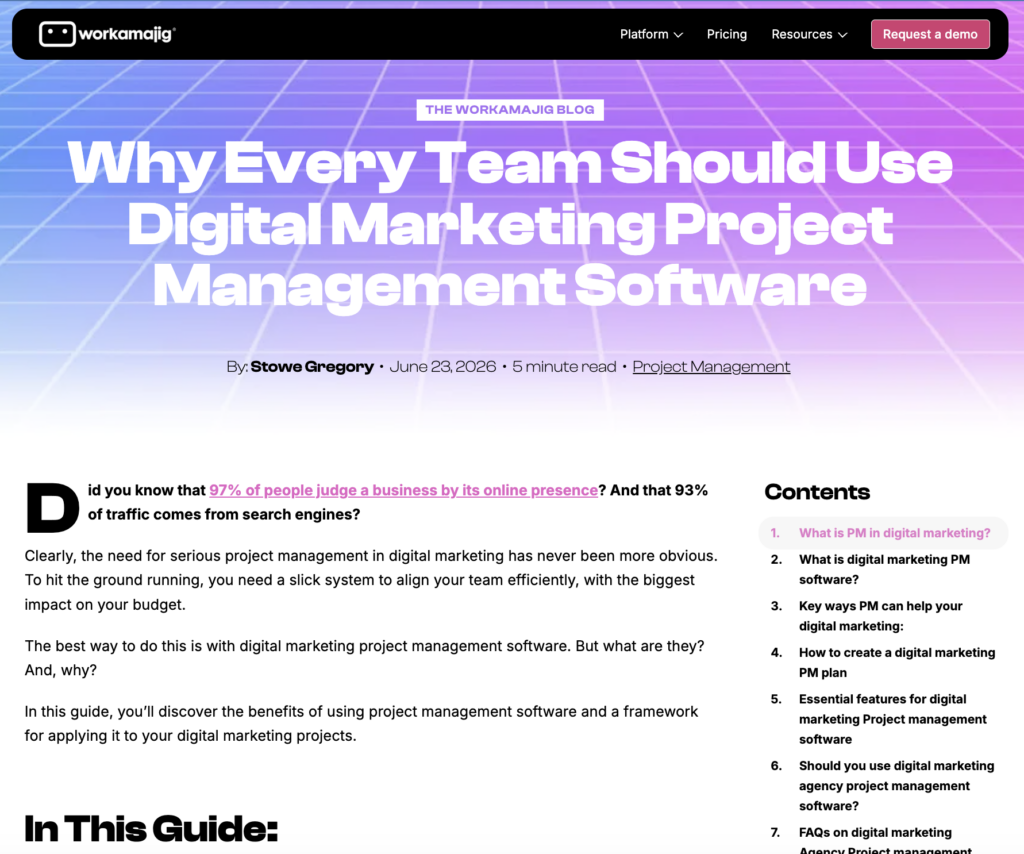
You can take various approaches to this, such as through general guides on the topic or get deeper and help with a particular question.
For example, while writing for Project Management Software company ‘Workamajig’, I often created blogs that explained different project management concepts. The readers would search for advice, find their answers within the blog, and then learn about Workamajig (as I’d mention how it can help in natural places throughout the article).
The result? Increased brand awareness and new leads.
Product-Led Content
Product-led content is, as the name suggests, about directly promoting the software’s qualities. These types of SaaS content can be case studies, workflow examples, or tutorials.
Product-led content is often high-converting, as it can significantly boost trust in a reader, answering “will the software work for me?”
For example, this blog by Adobe on “Why music video pros choose Adobe Premiere Pro” tackles that question head-on.
Comparison Pages (Middle of the Funnel)
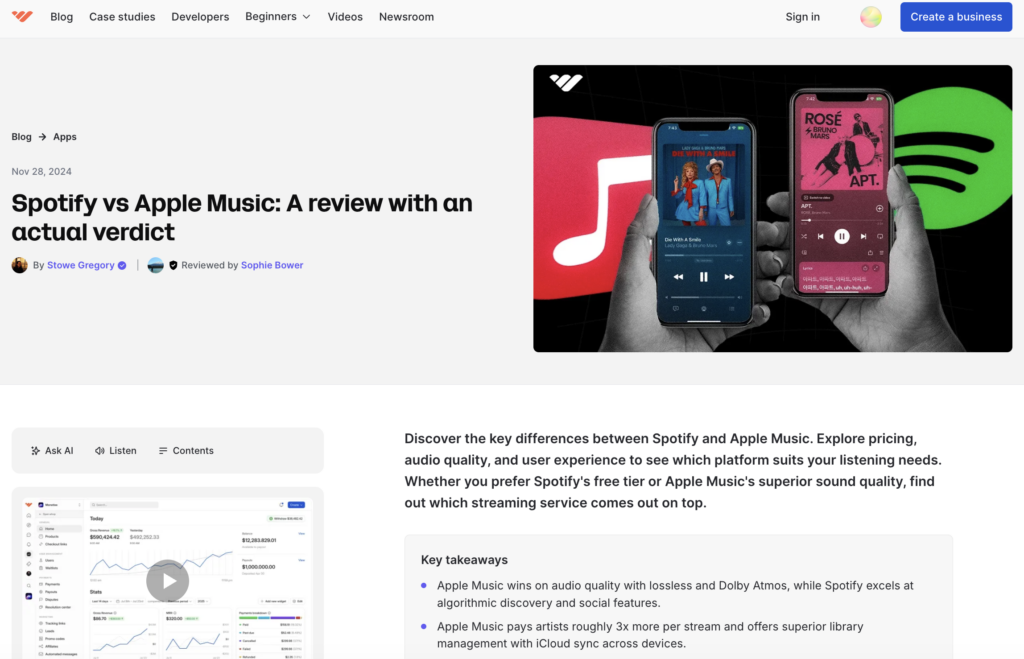
SaaS comparison pages help highlight where software shines vs. competitors. They’re very useful for increasing trust and capturing competitor audiences.
As a SaaS content writer, you must research what competitor software offers, find their weak spots, and understand how your product is better or unique. This can often require some hands-on use before you get to tapping away your words!
Here’s an example of a comparison article I did, comparing Spotify and Apple Music.
Case Studies (Bottom of the Funnel)
Arguably the best way to build trust is through a case study. This type of SaaS content uses statistics, facts, and real-world examples of your software’s success to convince the reader of its power.
Case studies can immediately answer any doubts your audience may have about your product, with irrefutable facts.
You might need to interview clients and dig deep into data sheets before you get started. Then, you’ll need to use your storytelling skills to make a convincing and authentic document.
That’s easier said than done and something AI can’t do, which is why many freelance SaaS content writers really deserve their pay.
Tutorials
Tutorials verge on technical writing, but we SaaS content writers are versatile folk. They act as guides for existing customers to understand features, but also as a promo to your untapped audience.
Knowledge bases, FAQs, or step-by-step tutorials should all be used at some point to show how your tools solve problems.
How SaaS Content Helps Growth
Good SaaS content supports growth at every stage, from discovery and understanding to sign-up and retention. Let’s take a closer look:
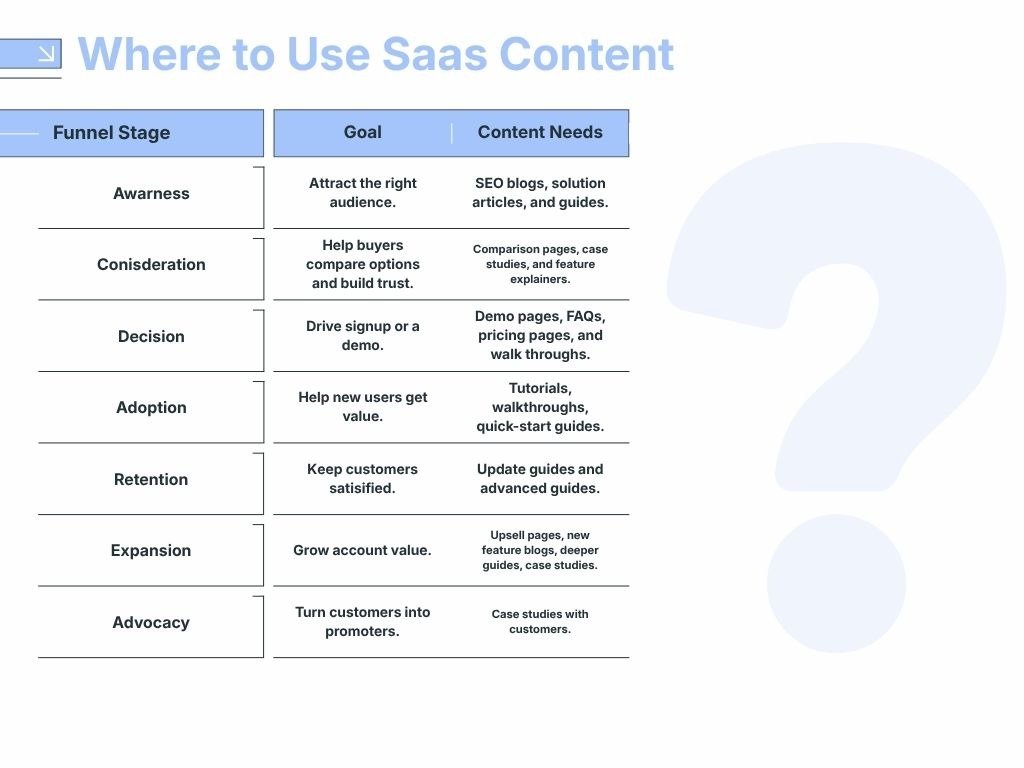
Discovery Signups
Converting your reader to signups is the ultimate goal, right? That’s when your investment in promo through writing pays off.
Saas blogs achieve that over the long term by getting your articles to the top of popular search engines or AI queries. Your brand will become a recognisable name and voice in its industry.
Those people already looking for a solution will learn how the product solves it. Achieving that is critical as most readers won’t convert unless they fully understand the value.
In my experience, this is where content is the most impactful.
Product Adoption
Sign-up on trialing a software is the first step. Next, it’s making sure the user sticks around.
Onboarding guides, tutorials, and help articles are the answer here. They reduce confusion and get people to see the true value in the product.
Retention
Over time, users may start to look at competitors. New features and shiny promos can lure them away.
SaaS content writing can prevent that by shining a light on the deeper value of your product. This could come in the form of scheduled blogs on ‘How our software solves X’ (with a different problem tackled each week).
As they see how they can improve their workflow and get the most out of your software, they’re less likely to move away.
As any SaaS business will know, recurring revenue keeps things rolling, so retention-focused content should never be overlooked!
Expansion and Trust
The final way to use SaaS content is through expansion and trust building. This is all about building upon your success. You can do this via feature blogs and case studies that showcase the best use of your software.
How to Make SaaS Content Convert
Value First
At the heart of converting any reader is clearly stating the value of the product early on. The strongest results in my work come from focusing on the solution the reader is likely looking for, followed by how it’s done.
Don’t Overwhelm
Complex features are naturally complex (shocking, I know). But, as a SaaS writer, you must make it easy to understand at first glance.
You don’t need to get into all the mechanics and fancy coding talk. It needs to get to the point. This is more important than ever in today’s short-attention-span world.
State what the feature solves and achieves and how it can apply in a practical example.
I achieve this at the end of all my Workamajig blogs; selling the product’s in-depth potential, with minimal overwhelm.
Use Proof Carefully
Data, stats, reviews, and screenshots are your ticket to building trust.
But use them strategically. Don’t bury them far below the relevant point or out of context.
And don’t overdo it! Instead, weave it into your storytelling, rather than in bullet point lists (of course, there can be exceptions where that is suitable too).
Common Mistakes In SaaS Content Writing (And How To Avoid Them)
The most common mistake I see SaaS content writers make is focusing on features instead of solutions and failing to include proof.
SaaS content works best when it speaks to a specific pain point and solution, rather than getting generic. If it helps, define your audience first and write to their exact problem, not a broad market.
When it comes to features, explain why each one matters (such as saving time, reducing errors, or collaboration).
Merely stating a feature is a bit like saying, “This new energy drink gives you energy”. It’s not as convincing as saying, “This new energy drink gives you the energy to continue to perform at your peak for the entire game”. Real-world examples work best!
Finally, a weak SEO strategy means you’re wasting your time. Do the SEO research beforehand, with a strong long-term strategy. That way, you’ll target the search terms your solution fixes and match how buyers actually search.
Why Trust Me as Your Saas Content Writer?
As you can see, SaaS content writing requires you to go beyond what’s required in most levels of content writing. Concepts can be complex, and reader attention can be fragile.
As an experienced SaaS content writer, I know this firsthand. My work includes deep research so that I am deeply familiar with your product, its industry, and your competitors.
Once it’s ingrained in my neurons, I then use my craft to myself in the shoes of your audience. I write with their mind considered, helping to show how your product solves their problem, with clarity and proof.
Get Words That Sell, Today
With a reputation for punctuality, a strong understanding of marketing goals, and a knack for making the complicated become easy to understand, you need look no further. My work has been trusted by leading software companies in project management and e-commerce spaces.
Feel free to contact me today for a free chat or to view my samples here.
One response to “The Pro’s Guide to SaaS Content Writing That Converts”
[…] The Pro’s Guide to SaaS Content Writing That Converts […]