
Anyone active on LinkedIn or following marketing gurus will see one of today’s most popular buzzwords, ‘storytelling content’ or ‘story-driven content’.
It often causes confusion, because it sounds like you’re about to write a short novel.
Really, it’s a very effective writing strategy that’s all about tapping into the emotional side of your audience’s needs. It’s about meaning, more than facts.
It’s used by about 69% of agencies and is an integral skill for any modern content marketer.
As an experienced SaaS content writer and law content writer, it’s an often-relied-upon part of my work. So, let’s help you get your head around it:
What is Storytelling Content?
Storytelling content, or narrative-driven content, is a marketing approach that uses narrative and real-world examples, rather than facts and hard product sales.
Instead of listing features and technical jargon, the content draws the user in with emotion, characters, and a clear solution provided by the product or service.
We’re looking to get their imagination flowing.
How Popular Is Storytelling Content?
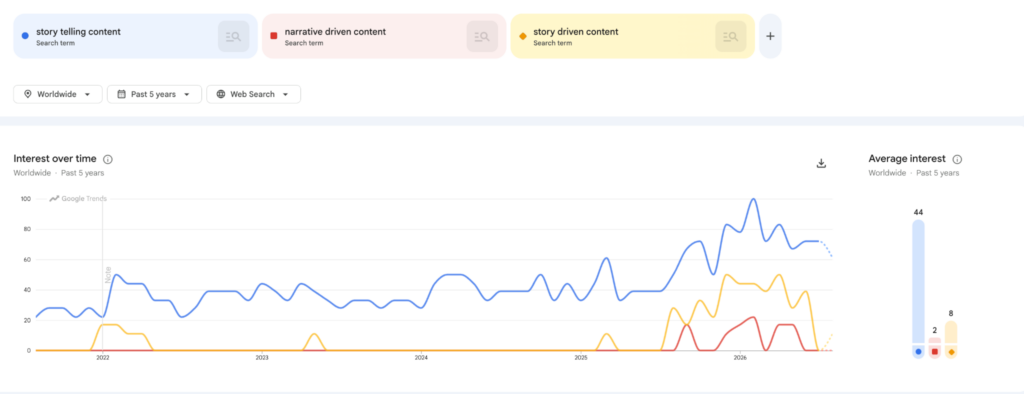
Story-driven content has seen a surge in interest in recent years, with marketing teams becoming more and more aware of the impact of human-led, emotionally driven content. Search terms have seen over a 250% increase in the past 5 years.
According to the Content Marketing Institute, 69% of agencies said they always or frequently use storytelling in their content,
And while not limited to content, research from the IPA Effectiveness Databank found that campaigns focused primarily on emotional appeal generated a 31% increase in profitability, compared with 16% for campaigns relying mainly on rational persuasion.
Ok. See, stats can be boring. Let’s look at how it works.
How Does Story-Driven Content Succeed?
It goes without saying that tapping into your audience’s pain point is a great way to convince them about your brand’s benefits.
Storytelling content achieves that by painting a picture through words.
For example, with my own content writing services, I’m tapping into people who want new leads and new conversions.
Technically speaking, my audience is likely struggling with their SEO output and a lack of authority. But emotionally, they’re afraid that their business won’t survive unless they bring in new clients. If they don’t have an online presence that brings organic traffic, they’ll be left behind.
So, to tap into that need, I turn to storytelling. Let’s look at an example.
Examples of Narrative-Driven Content
Let’s imagine a project management software company has crafted two pieces of content (factual content and story-driven content):
Factual Content
“Our project management software features real-time data and automated reports. Everything is under one roof, allowing your team and clients to view data, progress status, and billing at once.
We’re trusted by over 1,500 companies in software, web design, and e-commerce. We reduce time lost by 7 hours per week and increase report opening by 54.3%.”
Story-Driven Content
“Before turning to us, MyDesignXL was overwhelmed by the sheer amount of reports they had to produce, email, organize, and get signed off every month.
It was causing chaos for their clients who wanted to receive them on schedule.
By using our project managmnet software, they’ve been able to enjoy automated reports, sent out at a scheduled date and time. Their clients have also been able to view progress and billing insights with total freedom and confidence, thanks to real-time data.
Since then, MyDesignXL has freed up dozens of hours and increased their client retention rate.”
Stories are More Memorable than Stats
With these examples, you can quickly see (and hopefully feel) the difference. While there’s certainly a place for the factual approach, the story-driven approach in this case creates an emotional connection.
This can ensure the brand stays in the mind longer than competitors who might just be using facts.
It instantly forms a bond and helps the reader imagine their team in the same shoes. Stats and facts aren’t so great at that.
Stories Make You Feel Human
AI slop and cold marketing is everywhere right now. People are feeling fatigued by it.
People want to interact with a human company. Stories connect to them on a human level, with a sense of real-world impact.
Whether it’s a customer success story (like in my example above) or a founder’s journey, or a pro tip’s insight, it makes you feel approachable and human-led.
Stories Make Complex Ideas Easier to Digest
Facts and jargon can be overwhelming. Especially with our short modern attention spans. (By the way are these paragaphs short enough?)
You have to connect in a relatable way. Stories do that brilliantly.
For example, in my legal content writing, I have to make regular people quickly understand the implications of laws and their options. Listing statutes doesn’t cut it.
So, I often explain a law firm’s capabilities through success stories. Here’s an example :
Instead of saying,
“We work hard to negotiate with insurance companies to recover the damages that can help you recover. This is possible thanks to the state’s at-fault insurance laws.”
I have said,
“After our client was tragically rendered a paraplegic in a road traffic accident (as a pedestrian), we secured a significant settlement that she desperately needed to adapt to her accommodation, which was simply unsuitable.
We worked hard to make short-term accommodation adaptations before securing the funds required to buy a suitable, accessible home. This allowed our client to return home as soon as possible, alongside the support and rehabilitation necessary to help her move forward with her disability.”
As you can see, the impact is emotional and paints a clear picture of what’s possible. There’s no need to get into the nitty-gritty of insurance law and negotiations. Instead, create the scene.
How Can I Create Storytelling Marketing?
Here are the most important factors I keep in mind when creating narrative-driven content:
Authenticity
If you can, always use a real case study or success story.
If you can’t do that and have to get fictional, keep it realistic and in line with your values. Readers can easily tell when something’s been truly faked.
You can also encourage users to share their stories, creating a community around your brand.
Know Your Audience
Before you even start writing, ensure you know your audience, their demographic, their preferences, pain points, and goals. This will ensure your story hits hardest.
Keep It Clear
Try to keep the emotional message clear. Direct your narrative towards key selling points, rather than overwhelming them with every benefit you could possibly think of.
Evoke Emotion
Most importantly, create emotion! Whether it’s joy, fear, inspiration, motivation, or relief, you must create an emotional connection.
This can be done through the scenario and the words you choose. Get tugging at those heartstrings, setting fires in their mind, all to get them dreaming.
I also advise throwing in some photos and videos where possible to really bring it home.
Don’t Rule Out Data
While storytelling content isn’t about numbers and facts, I personally think they still have use.
When used sparingly, like the salt on a dish, they add some credibility and power, showing your text isn’t just self-loving prose.
Hit Your Audience Emotionally, with My Story-Driven Content
If you’re looking to convert and are struggling with your usual content marketing techniques, then let’s change that.
As a full-time content writer and creative type, my words get to the heart of readers. I’ve seen these techniques connect and grow audiences time and time again.
Feel free to send me a message today to get started.
FAQs on Storytelling Content Marketing:
Storytelling content marketing is the use of narrative and real-world examples to emotionally connect with readers, rather than hard product sales and technical jargon.
Storytelling content creates an emotional connection with the reader, which is shown to create a lasting impression and sense of human connection.
Storytelling content can cover customer stories, brand stories, product stories, and employee stories. Ideally, these are real case studies, but when done well, fictional stories can also work.
Related reading: